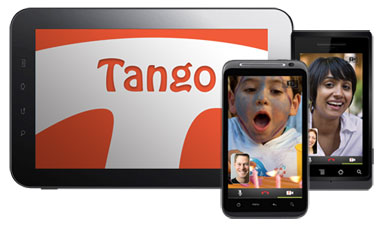
For those of us who grew up with the Jetsons, the cliché futuristic image of Jane talking on the video phone has persisted even into 2011. But naturally it wasn’t until Apple introduced FaceTime that a real video chat market started to take shape. Yes, Skype video has always had a dedicated user base, but FaceTime was the catalyst for other players to join the game. Here’s a look at a few of the current companies and new offerings in the video chat space.
G+
Google took video calling a step forward with the launch of Hangouts in its new Google Plus social network last month. Create a free Hangout, and you can video chat with multiple people at once. Only problem? Yeah, you have to be a G+ user. If a recent Mashable poll is any indicator, users love Hangouts, but G+ is already getting a rep for only attracting techy types, and that’s a serious limiting factor. Google has said it will open up G+ video chat to third-party apps. Perhaps that will propel the technology beyond the techy cohort.
Facebook with Skype (er, Microsoft)
Not to be outdone by Google, Facebook followed the G+ launch with its own video chat service powered by Skype. The new, free feature has the advantage of debuting with a ridiculously large user base, and it’s sure to drive up bandwidth usage among a subset of Facebook fans. Meanwhile, the fact that Microsoft has acquired Skype means that the technology itself will continue to get integrated in non-Facebook apps as well. Microsoft has already said “Skype will support Microsoft devices like Xbox and Kinect…”
Two to Tango
A friend introduced me to Tango last year, and it is still my favorite video calling app because of the cross-platform support. I live in a mixed-platform household, and with Tango I can still reach my family’s iPhone users with my HTC Thunderbolt. The app is free and extremely easy to use, and it automatically shows me who in my contact list is already a Tango user. Apparently I’m not the only one to like Tango either. The company announced another funding round of $42 million less than two weeks ago. Tango also says it will be available for PC users in the next few weeks.
Comcast Goes Technicolor (More Skype)
Cablecos have every incentive to make money off the increasing video traffic traveling over their networks, and so an operator-based video calling service is no big surprise. Back at The Cable Show, Comcast demoed a new “Skype on Xfinity” app for video calls on your big-screen TV. The service will start in trial form later this year, and we discovered last week that Technicolor (formerly Thomson) will provide the adapter device needed to make it work. No word on pricing.
Verizon Test LTE Video Chat
Although it’s only in demo form now, Verizon is apparently testing out a new video chat feature for its 4G phones. At the recent opening of its LTE Innovation Center, Verizon showed off a pretty sweet looking video app on the HTC Thunderbolt. Details are decidedly scarce, but if the app works as showed, it could be a contender.
“But naturally it wasn’t until Apple introduced FaceTime that a real video chat market started to take shape. ” Complete rubbish. There has been skype, Yahoo and MS Messenger long before Facetime. As long as Facetime is only on iOS and Apple PCs it is actually a failure.
You may not have used video until Facetime, but that is not true for millions of others.
Mari’s more familiar with video chat than most having worked Motorola’s ill fated Ojo initiative. Her point is that Apple has a way of taking technologies mainstream and that landscape has been expanded.
I think you may have undersold the importance of Skype on Facebook. I think making this thing easy to use for the hundred of millions of Facebook users will turn out to be absolutely huge.
I’m not holding my breath for the Comcast product. It certainly would be nice to sit back in the family room and have a video chat with family around the globe, but a) I’m not holding my breath for Comcast to release this, b) it’ll only work with some new STB that most of us won’t have, c) I bet Comcast will want money for it, which given the alternatives means nobody will use it.
I’d love it if I was wrong though. Would even use it. But I’m not paying a monthly fee on top of my already ridiculous Comcast bill when I already have Skype for free, Skype in Facebook for free, Facetime for free, etc.
I’ll be interesting to see if Facebook implements Skype in their mobile clients… that could be the watershed.
Skype has the “mass” adoption to make it matter. In other words, more people have heard of Skype & even know what it is/does, more people have it on their phone & computer etc. It’s not necessarily the best, but that is a big advantage. And as Dave says, integrate it into Facebook mobile…
I do use Google + and like it a lot. It needs to be mobilized soon though. Tango is pretty darn good – just unknown to most.
I love the new mobile video chat built into Android 2.3.4. Works across all PC/MAC/Linux gmail users and all Android tablets and almost all android phones released in the last 6 months with no software to install besides the browser plugin on a computer
There is plenty of room in the chat app market for both Apple and Microsoft, which is a win/win situation for consumers who want the best in chat apps that competition provides. Because I frequently communicate with foreign speakers for business, I don’t know where I would be without Transfire, which allows me to send and receive messages in at least 50 languages. It’s quick, easy, and I can upload my Facebook, Google Chat, and Twitter friends.