All your digital media goodness.

Obviously, the current hot topic in HTPC land is Hauppauge’s upcoming HD PVR… And I just heard back from multi-OS SageTV CEO, Mike Machado regarding their integration plans:
We’re working to support the HD PVR as soon as we can. We expect we’ll support it at or near launch.
I didn’t probe too deeply (hey, it’s the weekend), but I assume the PC version of SageTV’s DVR software would receive support first. Not to mention, support is probably dependent upon the drivers Hauppauge provides. (Their specs page isn’t OS-specific, though the safe money’s solely on Windows.)

Hauppauge has released details and announced timing for their USB HD recording device. The HD PVR records from component and optical inputs at up to 13.5Mbps in H.264. Additionally, AVCHD recordings can be burned to DVD for Blu-ray STB playback (via bundled ArcSoft application suite). Shipping is expected to begin May 1, and a pre-order page (presumably, with pricing) should be available in the near future.
Brent Evans has been really fired up about this box, as the one of the first consumer-grade HD encoding devices - allowing folks to bypass a specialized, certified HTPC (BIOS/firmware) with CableCARD tuners to record digital cable at HD resolutions. I’m somewhat more restrained… To fully appreciate this, one would need a computer, the Hauppage box, and a cable or satellite set-top box co-located. Which may be too much clutter for many living areas without an AV closet. (It is for me.) And until (if) this product is integrated into Windows Media Center, extension options are limited. Brent assumes we’ll see support from BeyondTV and SageTV at launch, though I’m not counting my ducks just yet. (I’ve checked in with both CEOs and hope to hear back shortly.) Actually, my main concern isn’t integration into those PC DVR software products. Rather, I wonder about the breadth of STB IR support. (Though the box IR receiver could conceivably be used to learn commands.)
While the HD PVR will record high def content it’s re-encoding analog output rather than making a bit-for-bit digital copy of the original. I’m sure it’ll look good and the reported max bitrate is actually higher than I had expected, but it’s not the same as recording directly via CableCARD or ATSC OTA. (Which may not matter if some of these recent cable-co compression stories are accurate…)
Keep an eye on Brent Evans Geek Tonic for updates.
In yet another example of Canada’s broken broadcasting policy, Canada’s national broadcasting regulator, the CRTC, has denied John Bitove’s (XM Canada’s founder) HDTV Network Inc’s application for an eight city Canadian HDTV broadcast network. The network was to be backed by Microsoft founder and Charter Communication’s chairman, Paul Allen.
Most Canadian cities have few or no digital broadcasters. Global has repeatedly missed the CRTC-imposed deadlines to launch its terrestrial HD broadcast system in Canada. Here, a proven entrepreneur was denied the right to do that which a national Canadian broadcaster is unwilling or unable to do.
Why? Because the network was not committing to broadcast enough local Canadian content. Content that most Canadians neither want nor watch.
It was heartening to see one commissioner, Len Katz, dissent.
Canada’s broadcasting policy is in need of top to bottom overhaul with an emphasis on market-driven competition and integration with U.S. broadcast and telecom policy. Until then, Canadian consumers are left with an increasingly sub-par and antiquated broadcast system.
Dale Dietrich is a Toronto-based technology, video game, and interactive media attorney. Read more at The Daleisphere.
The Spring edition of CTIA’s biannual wireless convention has just wrapped in Vegas. There were a variety of interesting announcements and new (or upcoming) products, but no larger revolutionary trends. Most chatter seemed to revolve around the health of the US economy (and what it means to the industry) and the lack of concrete WiMax service details (timing or pricing). Sadly, the phones I most wanted to fondle (Sony Ericsson XPERIA X1, Nokia N96, Garmin Nuvifone) were all behind glass. In fact, several exhibitors seemed extremely concerned with industrial espionage and controlling messaging… For example, both Motorola and Samsung chose to prohibit photography in their booths. I did manage to periodically sneak away from our Sling kiosk in the Symbian booth and shoot some videos which are posted to Qik and Flixwagon (with possibly more to come).
Apr 2 2008
A periodic roundup of relevant news… that Dave hasn’t had time to cover while attending CTIA:


As the regulars probably recall, I’m pretty lazy when it comes to audio. I love all sorts of music, but I’d rather let someone else acquire and assemble the playlists. Sure, I’ve ripped hundreds of CDs (not to mention those DRM-encumbered purchases), but there’s artists I may not yet know of or haven’t remembered to add to the collection - and I just don’t want to continually chase down random tracks. Which is why I enjoy services like satellite radio and Pandora-esque online streaming.
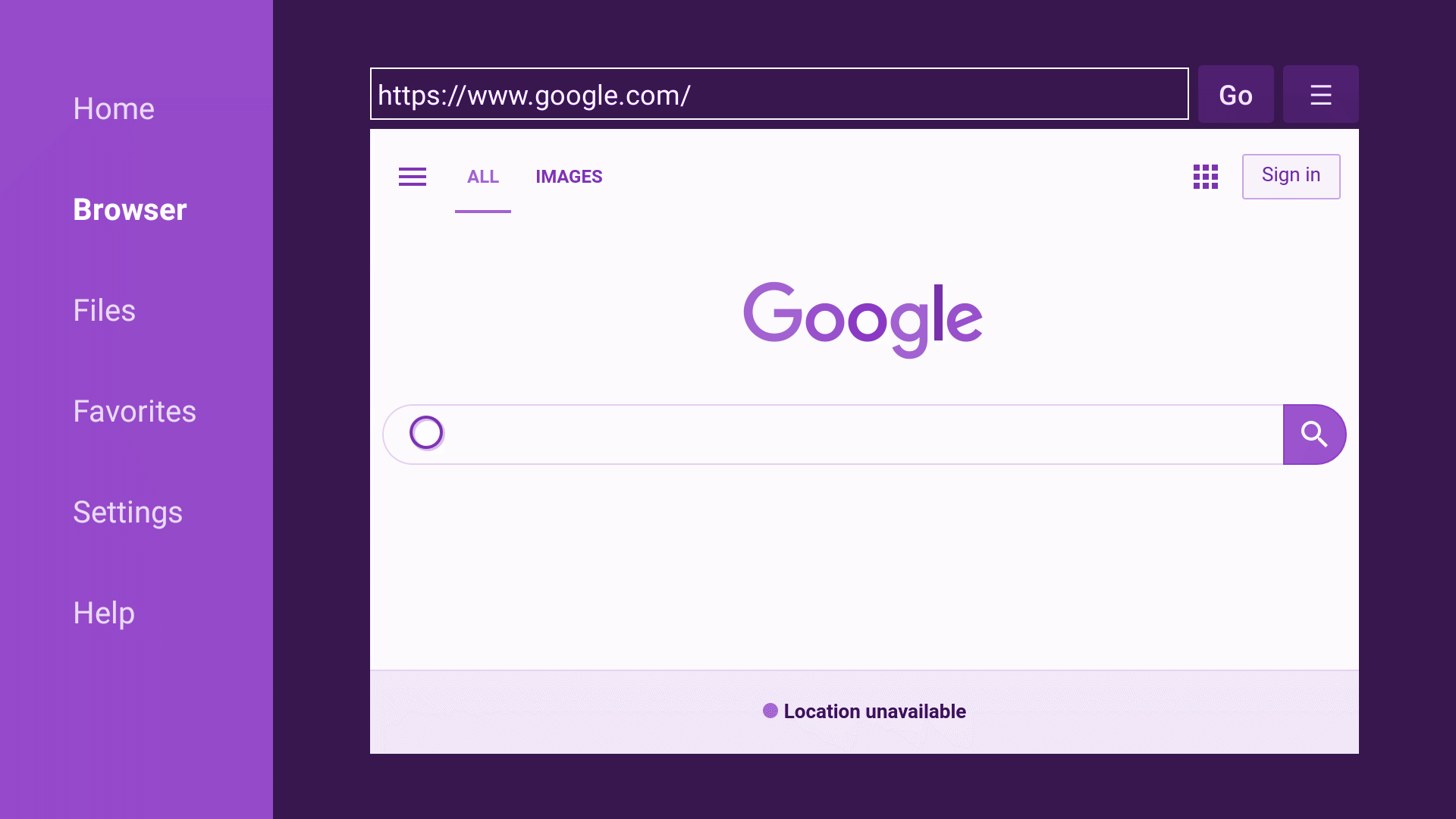
After writing up Airfoil for Apple TV, Earl mentioned he uses Rogue Amoeba’s Audio Hijack Pro - a nice OS X recording application. I picked up a copy ($32) to use in conjunction with the XM Dashboard widget (which utilizes mplayer, selected in the pic above). The widget’s not elegant, but it does keep the audio streaming beyond the 2 hour timeout…
So, I’ve married these two products and possibly violated the XM EULA to create a 10 hour low fidelity (64Kbps?) recording of Lucy which was automatically inserted into iTunes and synced over to my iPhone. It makes for perfect background music while blogging, reading, or dozing on the plane. In fact, this post is being composed while wearing my Shures on the flight into Vegas.
I intend to make a few more recordings of my preferred stations. And being a good digital citizen (on my terms), I’ll delete the files if I unsubscribe to XM at some point.
Ed Hardy of Brighthand demos Redfly with AT&T Tilt (4:51)
Newer Samsung phones with guest appearances from Laptop Mag and PC Mag (2:32)
MagicJack, the $40 VoIP dongle (3:08)
Motorola WiMax router and Femtocell (2:22)
Motorola’s DVB-H PMP (1:38)
Plantronics fashion bluetooth headsets (0:31)
Thumbplay allows free video sharing to mobile devices (3:05)
While most of the industry is focused on the wireless world at the moment, Broadband Reports has the news that Verizon has apparently launched HD VOD in some areas. It’s a good application for the telco’s fiber network. Lots of bandwidth drain.
Any ZNF readers enjoying VZ HD VOD yet?