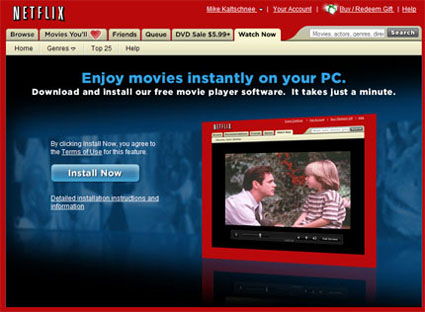
For some time Netflix has indicated they would announce their download strategy in January… and here we are! Initially, they will offer about 1,000 streaming movies (via their web page, Windows PC required) at the rate of 1 hour of video for every dollar you spend on monthly Netflix service. Depending upon your available bandwidth, quality can scale up to near-DVD quality. Deployment begins today and will be available to all customers by June.
Netflix has come up with quite an innovative pricing strategy. In its current form (PC-only viewing), I’m not sure how many new customers they’ll acquire… But perhaps this service will limit some (high profile) defections to Blockbuster. Though they’ve introduced a pricing inequity issue with a staggered roll-out: Mike gets “Watch Now.” Dave does not. We both pay the same, yet his service is now superior to mine. Netflix better be prepared to activate everyone who requests the feature or risk alienating customers.
So far, they’re not off to a good start. The first thing I did this AM was email customer support and ask to have video streaming enabled and this was Verna’s reply:
Dear Dave,
Thanks for your message.
I appreciate you inquiring about “Watch Now” feature, at this time we do not have any information on this feature. I have enclosed the list of plans that are available.
Here is a listing of the various program sizes we offer:
[…]
If Netflix “do[es] not have any information on this feature” that they offer, who does? I sure hope Netflix ultimately partners with TiVo, Sling, etc to get this content to my TV without requiring an additional set-top box.
If I can’t get it to my settop boxen (preferably my TiVo), and if it isn’t broadcast at a resolution & encoding quality) at least somewhat comparable to DVD (which is quite low to start with!), then this is DOA as far as I am concerned.
And are they picking folks randomly, when determining who gets this? Odd! Maybe they should set up a survey and find out who has broadband and who would like to ‘test’ this, and then offer it to those people first!
I can live with near-DVD quality for certain content in exchange for instant gratification… BUT I agree: The PC is not where I generally want to watch movies. Streaming actually puts them at a disadvantage, not only am I tethered to a computer but I must be online at all times (meaning no digital Netflix service on planes or in cars yet) and no one else in the house should be sharing the bandwidth for optimal performance.
Streaming puts them at an advantage with the studios. They don’t want movies on your boxen! They will get more selection that way. They’ll move to the set-top eventually. This is a nice way to offer up instant content. Hollywood is never going to allow ubiquitous HD quality downloads. Streaming will eventually win the battle, IMHO. The only way to protect the intellectual property is to control it’s playback. Not saying that’s good, but it is what it is.
BTW, if you want to watch a movie on the plane or in the car, take your DVD from Netflix with you! Only slightly more prep time involved.
You can enable “Watch Now” by:
1. Clicking the “Your Account” link at the top right of any Netflix page.
2. Click the “How can I watch movies instantly on my PC?” link in the righthand column of your account page.
Here’s their recommended system requirements that I saw after trying this on my Mac.
Minimum Requirements
* Computer running Windows XP with Service Pack 2 or higher, or Windows Vista
* Internet Explorer version 6 or higher
* Windows Media Player version 9 or higher
* An active broadband connection to the Internet
* 1.0 GHz processor
* 512 MB RAM
* 3 GB free hard disk drive space
Recommended in addition to minimum requirements
* An active broadband Internet connection of at least 1.5 Mbps
* 1.5 GHz processor
* 1 GB RAM
Grant: There’s no option to enable it. That page is purely an informational screen…. Says I’ll get it by June.
This is pointless. As others have said, I see no use for this. I’m not going to watch 2 hours movies on my PC. They need to partner with Tivo or XBox 360 to roll this out, since they don’t have any STB of their own, and even if they did I wouldn’t buy it. Obviously the cable companies wouldn’t carry a NetFlix service even if it were available. Personally I’d like to see Tivo integration.
It doesn’t need to be free. It can just be an alternate way to get your movies instead of via disks in the mail.
Feel free to DRM it so it only works on the Tivo it is downloaded to. I don’t need multi-room. I don’t need TTG. Just let me delete it when I’m done, and keep it until I’ve watched it.
As others have said, right now this is DOA. I don’t know why they bothered.
I tried it – it gleefully announced “This feature will be available in June 2007”.
Seeing as I hardly use NF already, this kind of slight may be JUST the reason for a spiteful defection to Blockbuster :)
Hmmm…it worked for me. I have access to the “Watch Now” page, and have successfully been able to stream movies. Guess I got lucky!
Dave,
Notice that this is streaming and it adapts for the available bandwidth and the viewing pane? Remind you of anything?
In an unrelated note, how about that SlingCatcher and hard drive attachment, and the vague promise of ‘broadband content’?
I’m just saying… ;-)
Given how long we have been waiting for Netflix’s TiVo partnership to show signs of life, it seems pretty lame that some users are able to get the Watch now feature and others can’t. Netflix should definetely set up a priority list so that users who have been looking forward to this feature will be able to take advantage of it.
Is there any reason you wouldn’t be able to watch a Netflix streaming movie on your TV via SlingCatcher?
Mari,
The SlingCatcher would have to support whatever technology Netflix is using for playback. If it is a Flash based player, then the SlingCatcher would need a browser and Flash to handle it.
Unless you could stream to a PC then use the Sling software to bounce it to the SlingCatcher. But since the video plays back in the browser, I don’t think that would be easily done – and control would be weak.
But note my tongue in cheek comment above – the way the Netflix system works sounds a lot like how Sling works. It is possible that Netflix is licensing Sling Media’s technology to do their streaming. Sling Media talked about broadband content delivered directly to the SlingCatcher in the future – this could be that content. Pure speculation, of course.
And the dormant TiVo/Netflix link could return too, with downloads or streaming to the TiVo. Maybe they’ll add video stream support to HME and there will be an HME-based Netflix player.
I was considering re-upping with Netflix once they confirmed details of their on-demand service (I’m a former subscriber who just ran out of time to watch enough movies to make it economical). I guess I just had too much faith in the rumors about the TiVo option that have been kicking around for a while, because that’s what would do it for me. Well, this just doesn’t cut the mustard, does it? Who the hell wants to watch 18 hours of video a month on a computer screen? Not even close, Netflix, and absolutely nothing like a cigar.
What happened to the Tivo-Netflix partnership rumor? http://www.msnbc.msn.com/id/5915470/site/newsweek
Steve,
It wasn’t a rumor, it was announced.
But since then it seems to have fizzled out, or, at best, gone dormant.