All your digital media goodness.
Licensed photo by AP/Paul Sakuma
While racing around Vegas during CES, I received a few inquiries regarding magicJack’s new cellular femtocell. Unfortunately, I missed them at ShowStoppers and the rep on the convention show floor was uninformed. Fortunately, post-show, I’ve been able to dig up some details (and a photo) via their PR firm. And magicJack’s solution is pretty wild.
Like the existing magicJack VoIP solution, a small USB widget is attached to your computer to route phone calls over the Internet for about $20/year. Unlike the traditional solution, used in conjunction with a POTS-style telephone or PC headset, the magicJack femtocell essentially intercepts registers your cellphone signal — allowing you to bypass your carrier’s network at home, saving minutes and potentially improving “reception” by routing cellphone calls through magicJack’s network.
I’m trying to get additional detail on supported frequencies, as all we know at this point is that the magicJack femtocell will provide at least some GSM coverage (think AT&T and T-Mobile handsets). But I’m also wondering if their solution is voice-only, or does it also handle SMS and data like the carrier’s own femtocell solutions? Lastly, we could use some pricing and timing details. Stay tuned, this one is hot. (And it should also be entertaining – as I doubt the CTIA appreciates these guys encroaching on their licensed turf and may have something to say to the FCC about it.)
Licensed photo by AP/Paul Sakuma:
After a few false starts, it appears XStreamHD will be launching for real in 2010. As they’ll begin accepting pre-orders shortly for an expected spring delivery. I was pretty intrigued with their product offering as first described at CES 2008. However, CES 2009 was disappointing with a zero-hour press conference cancellation — possibly related to a distribution deal or partner that fell through. This year, they’ve got working units along with a more concrete description of what the current XStreamHD incarnation provides.
XStreamHD consists of a central HD Media Server unit, starting with 1TB of storage, at least one HD Media Receiver for each TV you want to wire up, and an RF remote control. XStreamHD pre-fetches à la carte video-on-demand content (think Moviebeam, RIP) via satellite… which doesn’t seem overly efficient or cost effective (for them) given the vast number of broadband CDNs out there. The device also enables you to tune and record ATSC over-the-air (OTA) HDTV via three tuners. In addition the the HD Media Receiver, DLNA capable devices will also be able pull video from the HD Media Server. I found the UI modern and pleasant consisting nice graphics and transitions.
It’s an interesting solution for folks who’ve given up on satellite or cable. But, while $399 isn’t a horrible deal for a networked DVR with VOD, they’re also going to hit folks with a monthly fee (which wasn’t disclosed) for service, guide data, and VoIP calling to fellow customers (VoIP, but why?). Given how things have played out thus far, I don’t know if they can pull it off without a big name partner.
Click to enlarge:
Tonight at Digital Experience (in the Mirage), Ooma will unveil a slew of new VoIP goodness scheduled to hit Telo customers over the next few months. But first, a quick refresher… Ooma Telo is a hardware device (<$250) that provides pretty much unlimited domestic phone calling with no monthly fees utilizing whatever broadband provider you’ve got. Plug in your own POTS phones, as I’ve done, or pick up the new Telo handsets ($50) for more advanced functionality around the home.
The first new features ensure and improve to call quality. Ooma Pure Voice ensures solid connections with consistent audio on saturated Internet lines. Because you’re downloading too much BitTorrent. High Definition Voice, on the other hand, is specifically designed to enhance audio quality by increasing the ranges of frequencies transmitted.
On the Internet side of the house, Ooma will launch voicemail transcription with messages delivered via email or text message. Anyone using Google Voice understands the high convenience factor. (Yes, I leave myself voicemail “notes”.) Speaking of Google Voice, Ooma’s GV Extensions will finally launch to link the two services, including the ability to use your GV number for outbound callerid and providing one-touch access to GV voicemail.
But I’ve saved Ooma’s coolest new functionality for last. With the addition of a Bluetooth accessory (free to Premiere members, $50 for everyone else) you’ll be able to link the Telo to a wide variety of mobile handsets. Not only will this enable you to share your mobile phone book, but you can also answer your cellphone from your home phone. Meaning, you can leave it in that one corner where you get great reception. Additionally, you’ll also be able to answer your home phone using your Jawbone. Last, but not least, a $9.99 iPhone app is coming which will provide Ooma customers 250 minutes (additional domestic minutes run 1.9c) of WiFi calling each month. Extending the value of Ooma well beyond your home.
Need a Google Voice invite? Leave a comment and I’ll randomly pick at least 3 7 winners – hopefully tomorrow, before I leave on vacation. See our previous GV coverage here. If you’ve got invites you’d also like to share, let me know (dave@zatznotfunny.com) and we’ll work on hooking up even more of the ZNF community. And, yes, my Google Voice number really is 571-GIZMODO. I’m sure they don’t mind.
Speaking of holiday freebies, Amazon is currently giving away a $3 credit towards any MP3 purchase/download. Which could mean 3 free songs for you, no additional purchase required. Head on over to Amazon and enter the code MP34FREE.
Update: Thanks to Josh and tivoboy for sharing their extra Google Voice invites with ZNF readers. We’re now up to 7. If you too have invites in need of a good home, please drop me a line at dave@zatznotfunny.com.
Ooma Hub on the left, new Ooma Telo on the right
Ooma’s refreshed home VoIP hardware has started trickling into Best Buy brick & mortar outlets nationwide. And it’s safe to say that their full complement of retail partners will shortly have Telo ($250) inventory. I first caught sight of the product update last November and, like it’s predecessor (the Hub), Telo effectively offers unlimited US calling. (Currently capped at 5,000 minutes, presumably to prevent abuse by small businesses on tight budgets.) Unlike a Skype or magicJack, you can use Ooma products with your existing phone(s). Or pair Telo with new Ooma-centric handsets due next month ($50?). Additionally and optionally, Ooma offers a Premiere tier of service ($120/yr) and/or allows you to port a number ($40).
In the Spring of 2008, I worked out a trade (at the San Mateo Mogolian Hot Pot) with a former colleague who had relocated to Ooma – a Dash Express for a VoIP Hub. Having previously dumped Vonage due to poor, unreliable service, I was somewhat skeptical. But as a telecommuter and given the nature of my job at the time, I found myself in need of many minutes from a dependable service. And Ooma delivered. Up to several hours per weekday over many months, not once did I experience any sort of interference, a dropped call, or down time. Something I can’t say of Skype or magicJack (or Vonage, obviously).
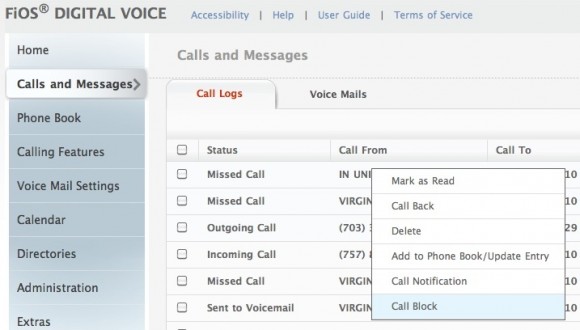
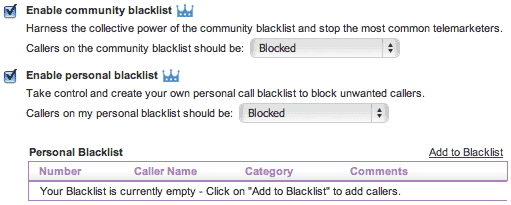
Given my current work and living situation, I no longer find myself in need of a home phone. Yet, as you can see from the pics, I managed to get my hands on the new gear anyway. Telo hardware is sleeker than the original Hub, with beveled edges and a touchable surface versus physical buttons. However, there’s something about the original Hub’s industrial silver metal look that I prefer. I wanted to run a Kill A Watt test on the refreshed device, versus my Hub results, but seemed to have misplaced the meter. I’ll just assume it’s more energy efficient. And will continue wondering what that USB port foreshadows. In addition to new hardware, Ooma has also refreshed their web portal – home to call logs, voicemail, and customizable blacklists.
Click to enlarge:

Mari and I have been following the Verizon Hub, from its pre-release iterations through the product that ultimately shipped in February of this year. And I’m sad to say that Verizon has decided to pull the plug. The Hub was designed to be both an Internet-connected widget station and serve as the household VoIP hub with a bit of PIM functionality thrown in to sweeten the deal. It probably wasn’t the meh resistive touch screen that did it in but, rather and as I predicted, a failure of marketing and pricing. Requiring the Hub to be purchased solely via Verizon Wireless at $200 plus $35/month with a two year contract is pretty steep barrier to entry when introducing a new product category to the mainstream.
I only know one person who picked up the Hub and it was fascinating to observe his initial excitement morph into disgust after experiencing months of issues – some technical, but most related to his account, billing, and phone number. So Verizon’s staff may not have been fully trained in supporting this device. (He ultimately managed to unwind it all and ended up back on Verizon’s typical VoIP service using his own handsets.) While the Hub is no longer being sold and has been scrubbed from Verizon’s web site, a PR rep informed me today that existing customers and contracts will be honored.
I do think there’s room on many of our kitchen counters for this sort of device. So I hope to see Verizon give it another go with a more robust platform and a better marketing/deployment strategy in the not-so-distant future. If not, one could just pick up a net-top.
(Thanks for the tip, Dave M!)
Jul 15 2009
Until now, Google Voice has been a web-only service to manage voicemail in the same way Gmail manages email. That’s no longer the case. But, as of today, Google Voice is a first class locally installed mobile application, available in the Android Market, deeply integrated with the Android operating system. (And there’s a less robust version for Blackberry here.)
Originally called Grand Central before being acquired by Google in 2007, Google Voice is currently in an invite only testing phase – but that may change soon judging by recent events. You can read more information about the general features of Google Voice mobile app for Android on the official blog. But in typical, understated, Google style there’s an intimated threat of two game changing features…
Voice mail karaoke

The “voice mail karaoke” has a scrubber bar, like found in iPhone visual voicemail, that you touch to fast forward or rewind the message. While listening to the audio, the machine generated transcription text follows along at the same pace – as each word is spoken, the corresponding text is highlighted red.
Before, one would often have to replay a voice mail three and four times over to hear the number correctly and write it down, only then to have to manually dial the phone to call the person who left the voice mail back. However, with Google Voice, if the person leaving you a voice mail message spoke the phone number they wish you to call them at, that number appears in the text transcription. So, simply long press the number and your phone dials it.
Free unlimited text messaging (SMS)
With Google Voice, you no longer need to have a text messaging plan with your mobile phone service provider or incur a 20 cent per message charge because text messages are sent through your phone’s data plan. Yes you read that correctly, that means free, unlimited text messaging. Currently, carriers like AT&T are charging the equivalent of $1,300.00 per megabyte for SMS. Testing performed in our secret ZNF laboratory show that barely two kilobytes of data were used to send each text message to other non-Android phones, all on different carrier networks.
How long will the good times last?
A recent Computer World article about Cisco Systems may be an indicator of storm clouds on the Verizon horizon:
Officials at Cisco Systems Inc. say they are closely watching Google Inc.’s aggressive foray onto their unified communications turf and plan to respond quickly by boosting the capabilities of Cisco’s offerings. Zeus Kerravala, an analyst at Yankee Group Research Inc.predicted that over the “long term, Google will have a significant role” in the business.Analysts said that the Google Voice Internet telephony service may pose long-term problems for companies like Cisco and Microsoft Corp.
Now that Google Voice mobile app provides retrieving of voice mails and sending of text messaging for free, do you expect the mobile carriers to sit on their hands and take no action as two of their most lucrative cash cows wither and die?