Zatz Not Funny!

All your digital media goodness.

Archive for the ‘Broadband’ Category

For about a year, and as directed by Congress, the FCC has been working on their (our) National Broadband Plan. With the goal of ensuring access while maximizing usage and potential. Whatever that may mean. But hopefully does not include Chatroulette. As you might imagine of a government report, the newly released National Broadband Plan covers a lot of territory. So instead of reading each of the 376 pages, take a look at DSLReports for some consumer-centric highlights. You might also want to hit Engadget for a few corporate responses. However, given our general focus here, I wanted to address the cable-co…

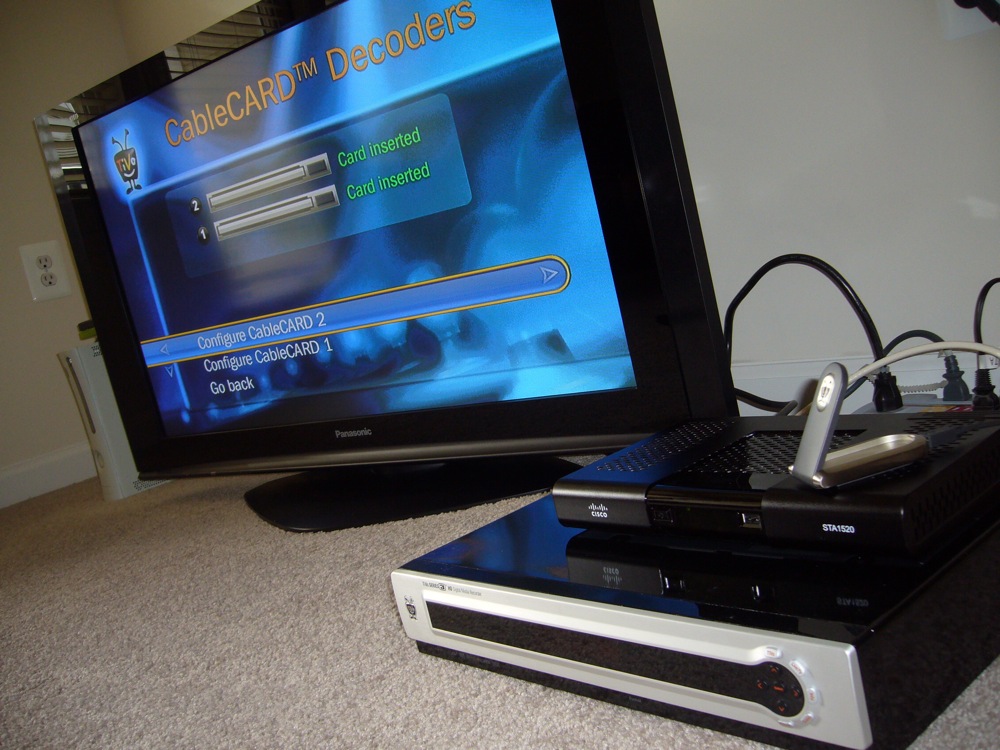
Section 4.13 discusses the current CableCARD landscape and associated challenges. Specifically, they address the SDV hurt fest, pricing obfuscation, “installation” hoop jumping, and CableCARD certification burden. And the FCC would like to see this all cleaned up by the fall. This year. It’s certainly a goal we can get behind. But, yeah, good luck with that.

Section 4.12 proposes more open access to a cable operator’s programming and services. In fact, they’re backing the “gateway” concept, suggested by TiVo and others in the CE space, opening the cable-co’s network to all manner of devices. Which certainly sounds more appealing than mandated cable-co UIs pushed down via tru2way (not long for this world?). Here’s what the FCC would like to see from a gateway device by 12/31/12:

  • Should use open, published standards for discovering, signaling, authenticating and communicating with retail devices.
  • Should allow retail devices to access all MVPD content and services to which a customer has subscribed and to display the content and services without restrictions or requirements on the device’s user interface or functions and without degradation in quality (e.g., due to transcoding).
  • Should not require restrictive licensing, disclosure or certification. Any criterion should apply equally to retail and operator-supplied devices. Any intellectual property should be available to all parties at a low cost and on reasonable and non-discriminatory terms.
  • Should pass video content through to retail devices with existing copy protection flags from the MVPD.

Of course, THE cable industry doesn’t quite see eye to eye on all points. As they’ve got a business to protect. And seem to suggest that IPTV and satellite television services should be held to similar standards. (Agreed.) We can also thank the NCTA for the title of this post. As it’s a direct quote. I don’t have a problem specifically with CardCARD technology but, as implemented, this ineffective regime needs to be overthrown.

Cablevision has always danced to the beat of a different drummer. Unfortunately, their ambitious (and quite logical) network DVR was tied up in a costly, multiyear battle with the studios. Now they’re at it again and will surely ruffle feathers as they pilot a “PC to TV Media Relay” service this summer. Basically, Windows software captures the audio and video from a PC to ultimately present the content via a television. However, unlike say a SlingCatcher or Netgear’s Push2TV software-to-set-top screenscraping, this feed is transmitted back up to Cablevision’s headend and broadcast back down as a private channel on one’s cablebox. Which is more reminiscent of the original ZvBox that utilized coax and clear QAM for in-home distribution. Piping the feed beyond the home does seem a bit inefficient. But it’s surely cheaper than replacing or retrofitting every broadband modem and/or cablebox. But where’s the controversy, you ask? Beyond personal photos and videos, you know this service is best suited for watching Hulu on the big screen. And their dinosaur studio genes naturally fear evolution.

Comcast made its big DOCSIS 3.0 push last year and boosted downstream speeds in most markets to 50 Mbps. According to Broadband Reports, however, the operator will go a step further and bring 100-Mbps speeds to 20% of its subscriber base by the end of 2010. And that’s just the beginning. Also on the horizon are downstream speeds up to 250 Mbps. That won’t happen this year, but a source suggests it’s not too far off either.

Does anybody really need speeds that high? And can networks support that much data usage? In answer to the first question, there’s room for experimentation with higher speed networks. Jokes about teleportation aside, we haven’t yet fully explored the possibilities of using a massively fast pipe for video conferencing, 3D modeling, medical applications, and more. Google certainly sees opportunity, hence the company’s announcement earlier this month that it will deploy fiber networks with speeds up to 1 Gbps in a few test locations.

In answer to the second question, well, it’s not entirely clear yet. We’ll have a better sense if and when we can examine data about actual consumer broadband usage. That may be easier once there are better measurement tools on the market. On that front, Comcast is making progress. After Dave tweeted the news that the operator’s bandwidth meter had made its way to the Boston market, Jeff Baumgartner went on to discover that Comcast has extended its bandwidth meter trials to some Seattle customers as well, and plans to add parts of Connecticut, New Hampshire, Massachusetts, Minnesota, and Texas to the mix by the end of this month. Parts of Utah and Colorado should follow soon afterward.

As consumers get a better read on their own usage, I’m betting we’ll start to see better aggregate data too. Bandwidth caps are one thing, but actual usage data will help us figure out if networks are up to the job of supporting higher throughput. Especially once higher speeds become less of a novelty, and demand for consistently higher throughput spreads through larger portions of the population.

CableLabs is holding its Winter Conference this week featuring, among other activities, an Innovation Showcase. To bring a little buzz to the event, CableLabs hosted a short media teleconference yesterday announcing the winner of Best Product Idea among the Showcase participants. Jinni got the nod from conference attendees for its “next-gen guide” including personalization features and an emotion-driven recommendation engine. (Test out the concept yourself at the Jinni.com website.) According to the Jinni execs on the teleconference, the company combines Web crawling with natural language processing and filters for more than 2,000 emotional attributes (witty, funny, etc.). The idea is to create a better VOD experience, and Jinni says it expects to announce operator deployments of an EBIF version of the app later this year. For back story, check out Davis’ post on the company back in January of 2009.

Beyond Jinni, Engadget HD also reported yesterday about RCDb’s Innovation entry, a technology solution that culls information from databases like IMDB and Gracenote and delivers it via tru2way to set-tops. Tru2way still hasn’t hit the retail market in any major way, but it is on the roadmap for, if not already deployed by, many of the major US cable systems.

Other companies in this year’s Innovation Showcase included Wowza Media Systems, SeaChange, Clearleap, and FourthWall Media (formerly BIAP). Separately, CableLabs also announced this week that it has completed the new EBIF I06 spec in conjunction with Canoe Ventures to support 3D technology development.

Dave broke the news back in August that Comcast would be coming out with a new remote DVR scheduling feature in the near future. Since then, I’ve kept an eye on the myDVR page in hopes I’d get a heads-up on regional availability. Today, after reading about guide updates over on the Comcast blog, I revisited the bookmarked URL and hit the jackpot. I can now manage all of my DVR recordings online. It appears that I’m in one of the early market rollouts, but the rest of Comcast’s digital subscribers with a Motorola set-top should get the upgrade over the next several months.

In addition to letting me manage recordings, the new myDVR Manager site includes decent search functionality with content filters (HD, sports, movies, etc.) and keyword results that incorporate both live broadcasts and on-demand offerings. The UI is easy to use and even anticipates what I might need next. A search on Duke, for example, let me quickly isolate just the Duke college basketball games.

The series recording options are also much easier to manage than they are on the traditional guide. See further pics below for a look at menus and options.

Sungale Cerberus G2 CES 2010 widget Android multi-touch touch screen

I’ve had both positive and negative experiences with Sungale products, so I advise caution when approaching their new-to-market devices. However, that said, the company does have some interesting products waiting in the wings. First there’s the Kula TV device, which has gotten the most press attention. It’s a Wi-Fi-based mobile TV product that provides “hundreds of TV channels” including BBC stations, ABC news, MSNBC, and even ESPN international content (watch the games you want, but get the commentary in Russian). The first year of service is free, and it will cost $5.99 per month after that. The Kula TV is due out in February.

More interesting to me, however, is the company’s upcoming Cyberus G2 product (pictured above). The first-gen Cyberus,  a touch-screen widget product, didn’t fare too well. But the second-generation device has more promise. It’s Android-based, full-screen multi-touch, and has a built-in camera and camcorder. I saw a working prototype in Sungale’s booth today, and the final hardware design on static display. The G2 has an MSRP of $399, but the suggestion from Sungale was that it will actually retail at a significantly lower price. The G2 should hit the market in June, and I’m on the list for a review unit. Stay tuned for the hands-on report.

Click to enlarge:

Clearwire CES WiMAX laptops Clear

There are numerous logistical challenges at CES, from long walks, to long cab lines, to the general press of humanity waiting to see the gadgets and celebrities on display. However, one hurdle I have not had to clear (pun intended) this year, is a lack of connectivity. Every time I pull out my trusty Motorola WiMAX adapter, I get full signal, even in the bowels of the Las Vegas Convention Center. Yesterday I got a post up while waiting on an appointment outside the Samsung football field booth. Sure, I was the idiot kneeling on the ground in a skirt and typing away on my netbook, but I was productive!

The Clear folks, meanwhile, have had a decent presence at the show, and I got a brief look at a line-up of WiMAX-enabled laptops at Digital Experience the other night. Clearwire also announced this morning that it is launching a new 4G network… in Spain. (?!) It’s the company’s first 4G service deployment in Europe.

While my good friend Paul Kapustka managed to get a Clearwire loaner USB card for his Vegas trip, I’m surprised that Clear isn’t giving away gear and temporary service to press and bloggers to drum up a little WiMAX excitement. I can’t think of a better venue, particularly in light of the LTE news flowing this week.

Twitter Microblog