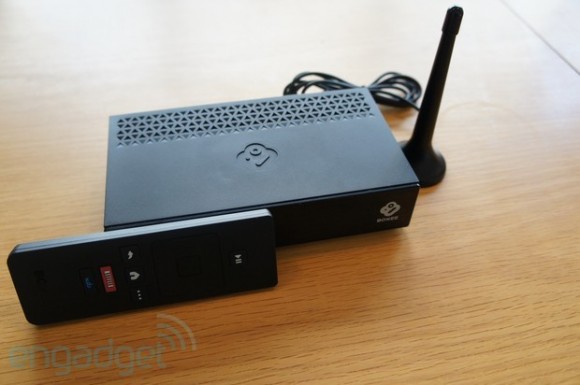
In what’s shaping up to be a fall battle of over-the-air DVRs, highly touted Simple.TV has started shipping while Boxee pivots away from local content aggregation into broadcast television archival. Yet, Simple.TV is anything but… by incorporating just a single OTA tuner and requiring owners supply their own USB storage, this remains the provence of geeks. Simple.TV hardware runs $149, but to fully unlock its recording and placeshifting capabilities (to devices like Roku and iPad) will require an annual $50-$60 subscription fee. Potentially more interesting is Boxee TV, which clocks in at a mere $99 for hardware… but similarly requires a subscription for full-on DVR and placeshifting functionality at $15/month in this case. While that may seem steep at first blush, the dual tuner Boxee TV is positioning itself as a cloud DVR and the fee includes unlimited online storage. Bonus: With or without that subscription, Boxee TV incorporates Apple TV-esque features like Netflix and YouTube apps while remaining on Input 1.
Questions about both devices remain. For example, what sort of quality and encoding are we talking about in terms of resolution and audio channels. Also, while Boxee positions itself as a potential cord cutting device, it’s often the cable “television” companies providing our Internet pipe… and associated bandwidth cap, which might limit the usefulness of a cloud-based DVR. Lastly, both Simple.TV and Boxee TV tout the ability to record unencrypted digital cable (aka clear QAM). Well, good luck with that now that the FCC has granted cable operators to right to encrypt basic cable.
And then there’s TiVo, the original DVR (perhaps), which also provides OTA recording capabilities along a handful of Internet apps like Hulu Plus and Amazon Instant Video. By comparison, TiVo Premiere hardware runs $150 and requires $15/month in fees. While storage is local, 500GB is included – which equates to 75 hours of HD recording. And one would assume recording quality would best anything transcoded and streamed to/from the cloud as Boxee intends. Unfortunately, TiVo doesn’t natively provide placeshifting capabilities as Simple.TV and Boxee TV do. Yet, for $129, subscribers can pick up the TiVo Stream — it’s pretty killer, but limited to in-home playback on iOS devices. Whereas one could presumably catch a Simple.TV or Boxee TV recording anywhere in the world they happen to be.
I think Simple.TV is a dud and I’m pretty psyched about where Boxee is headed… although I recognize their shift in approach will leave many prior customers and supporters feeling burned. The new Boxee isn’t entirely devoid of local playback capabilities, it’s just not the emphasis, and both DLNA and USB storage will be supported at launch… albeit with less robust codec support. Also, I learned from Boxee that DVR-ed recordings will maintain the resolution they were viewed in – although I assume there would be a loss in fidelity due to compression. Also, while it’ll pass thru whatever audio you receive, it’ll only record in stereo. Something to consider. Lastly, there’s something weird going on with the way they are launching only in select markets – I couldn’t get them to sufficiently explain to me why they’re doing it that way and feel like I’m missing a piece of the puzzle. Not that it’ll probably matter much to me… as it seems I’m still on the wrong side of the OTA digital cliff.
So when you press record on the new Boxee box, does it start sending the stream to their servers? That doesn’t seem right.
In terms of rollout, it would seem that Boxee would need to setup some type of data center in each market that can start the recording when a signal is sent from the Boxee box.
Yeah, I started asking about CDNs and such but they really didn’t want to go into that level of detail. I’d be willing to bet there’s some on board flash storage that temporary recordings are saved to before/as the content is stored to the cloud. Guess we won’t know more until we get our hands on it.
Regarding the QAM: Comcast has been using some sort of loophole with all of that to decrease the number of channels available. One of the things that impressed me about WOW when they moved into our neighborhood was their commitment to allowing access to QAM if you had at least one receiver in the house. They list the QAM channels online and even have a mailing list informing you of changes and when/if you need to rescan the channels.
I’ve no doubt Comcast, and the other big guys, will take advantage of finally scrambling those last channels. But the regional providers seem to understand people like me (a former cordcutter) came back to cable because they could find a company that treated its customers as customers and not just basic numbers. If they turn on us, we’ll leave them in droves.
In that regard, with cable users on providers like that, the Boxee stands a chance.
Maybe the are able to access each cable providers online library like Xfinity On Demand. When you want to record something, it sends a request to the provider and they allow access to that on your Boxee…that might work.
It’s all a mystery. :-)
Don’t discount Simple.TV though. I think they do have something there. I like the idea of being able to add your own hard drive for local recordings and the way you can stack boxes for multiple tuners. Wish the new Boxee had that as an option besides the cloud. Pricing for the Simple.TV box itself is a different matter.
@Geoffrey
Read some threads on Comcast that they are already starting to encrypt the local channels in some markets. I’m happy that I still have the option of getting decent OTA signals in the Indianapolis area.
The whole reason we all want to “cut the cord” is to remove recurring costs… Count me out for any “dvr” which requires subscription to be “unlocked” – $15/month for placeshifting TV – sorry I just don’t see the value here
btw: Boxee TV might not be out of picture just yet with upcoming Basic channels encryption.
New FCC mandated encryption scheme will allow software only decoding on authorized devices (aka Boxee TV)
Bored, yeah recurring fees are a turn off for many. But $5 or $15/mo may be a reasonable compromise for some and surely better than $100 or whatever the cable guys might charge. It could have legs and I believe Boxee’s approach trumps Simple’s. Of course it’s yet to be seen how these functions in the real world and if there’s significant number of folks interested.
Regarding the IP access and control of basic cable, I’m aware… but I’ll believe it when I see it. The cablecos have a long history of agreeing with FCC mandates but then failing to deliver. How many years did it take for CableCARDs to be supported as they should? And how many manufacturers (like Sony and Panasonic) gave up after being burned while the MSOs dragged their feet. So I assume the lockdown will occur well before IP access is engineered and made available.
@Bored
With FCC mandatad encryption, Boxee TV should just become an app on my Samsung TV.
@Dave:
Re:Costs We already saw the process when “rebel” all of the sudden started to sing together with incumbent (Google and Verizon or Boxee TV and Comcast)
As to price, as I said $5 might be worth considering… but $15 for beta service ….
As you said I’ll believe when I see it…
Re: FCC/IP Access – Thats is very true.
@Martin – Yea, right.. :Rolls Eyes:
From giga-om: http://gigaom.com/video/boxee-tv-cloud-dvr/
“The new Boxee TV device will come with a limited number of apps, which will include Netflix, Vudu, YouTube, Vimeo and Pandora. However, many of the apps available on the existing Boxee Box won’t make it onto the new device. “We don’t believe that the user experience gets better with a thousand apps,” Ronen told me.”
Are you S#!TTING ME?? Since when lots of apps = bad thing ??? Just ask Apple or Google how they like their app markets with millions of apps each…
I get the limitations of moving to new hardware platform and for small company it would be next to impossible to make 100% compatibility but FFS – quotes like this do nothing but reduce credibility of Boxee’s CEO and his company
Simple.tv’s lack of an HDMI port is their major fail. If people are going to pay a subscription fee to view and record OTA content, don’t you think they want it on the big screen, too?
Boxee failed in three simple ways. 1) crushing support for current customer base, 2) killing apps and file types on new box, and 3) the laughable $15/month fee. Who is going to pay that? Slingbox has problems making a profit and they have always had ZERO monthly fees. I can’t see a market for this device at all.
@Doug: Simple.TV’s expectation is that you can use a Roku to stream recorded content to your big screen TV.
Yeah, I don’t get how this “cloud DVR” thing makes sense. If Comcast builds an RS-DVR like product, they record the original show at the head-end from their feed, without having to upload anything from me. They of course they stream to me using QAM bandwidth which they have no CAP on.
Lets say they record at what? 5Mbps for 1080i HD? That’s much lower than any real cable provider (say AT&T U-Verse at 7.5Mbps for example) and they’re using a cheap real-time encoder on a chip vs. AT&Ts rack-mounted Cisco encoding hardware. But seems like a reasonable guess since its about what Apple and XBox use but below Vudu.
Well I have a Comcast 30Mbps down package, but only get maybe 5Mbps up on a good day. And I suspect that’s a pretty good number for the US. So I’d be lucky to be able to upload at 5Mbps. And at 5Mbps you’d use up about 2.2GB per hour. So an 8GB stick might record say four hours of TV if buffering was required. Seems unlikely they’d be using more than that. And 2GB of NAND is several dollars in low volumes…
And all of this assumes you’re only recording one show at a time of course. Is that true here?
Then there’s the CAP thing. Lets take Comcast’s new 500GB cap (maybe). 500GB @ 2GB per hour is 250 hours in a month. Well except its half that since you would both upload and download shows. Assuming you never watched anything live. So 125 hours in a month or a little under 4 hours a day.
Maybe this IS doable but just barely. And not with say Time Warner cable. Or households with more than one TV. Or …
I’ve been thinking about this overnight (because I’m geeky like that) and replaying my conversation with Boxee’s rep. And the only logical conclusion I can come to is that the recording is not local – why else launch by region unless you’re recording the shows with some centralized server and need the local ads or news. But since Boxee TV recordings cut out if you lose signal for example, they must be monitoring locally and syncing that up with what’s streamed back down. So my hunch is that they’re spoofing local recording. It would also explain the measly 1Mbps upload requirement.
So Nilay from The Verge, once a practicing copyright attorney, pushed them on this issue and says my theory is wrong and each user/show is a separate recorded file. But it seems we may have also received somewhat differing information from our discussions with Boxee and he also had some first hand experience with the technology. Hm. Looking forward to analyzing that local traffic…
https://twitter.com/reckless/status/258551493614006272
https://twitter.com/reckless/status/258551739114979328
https://twitter.com/reckless/status/258552350912954368
https://twitter.com/reckless/status/258556577370476544
I think that Apple is planning to do precisely the same thing as Boxee when it comes to putting live tv/dvr capabilities to apple tv. They win input 1 by offering all of the above- live tv, dvr, and apps. DVR can be added to iCloud. You’ll get a deal from your cable provider and get access to all your channels and shows on phone and tablet too. Get extra content on the ipad while watching live tv on apple tv. It’s what Steve “figured out.”
Xbox is going this way too with tv and remember that it doesn’t count against the cap. Yes, OTA people get screwed and but the providers will eventually start charging extra for this stuff so they will come out ahead. Verizon has been hinting at making FiOS TV available as basically an app that anyone can sign up to get for some time now.
John, Xfinity On Demand doesn’t count against the Comcast cap. But other services or providers wouldn’t necessarily get a pass.
Many changes for the cord-cutters on the horizon. I currently use Windows Media Center pulling in ClearQAM channels in conjunction HP x280n Media Extenders at each TV. I picked each one up for less than $75 used and they do what I need them to do. With the recent ruling, I now need to consider installing an OTA antenna. It is doable as I am within 30 miles of the local antennas.
I did consider Simple.TV until I realized that they do not have the ability to pool multiple Simple.TV boxes to gain multi-tuner ability. If you have more than one Simple.TV, you will have to sign in and out of your accounts to access the different tuners. Plus, once you start buying multiple Simple.TVs with lifetime subscriptions to gain multiple tuners, the cost jumps up significantly. No thanks.
I agree that Boxee has potential but as others have stated, the $15/month fee is a non-starter for me. I might as well sign up for basic cable and continue to use my WMC setup.
Unfortunately, I now have to have three boxes at each TV to get the services I like – the HP media box, an AppleTV and a Roku box. Each one has its pluses and minuses but at least each solution has been very stable.
I am in the process of setting up an older Mac mini (2010) as my Windows Media Center (via Bootcamp) to get rid of the Dell tower that I currently use. I am moving to a smaller office space in our house and need to save space where I can. But now I also have to think about an antenna installation.
Any recommendations for websites for antenna reviews?
@Gilbert solidsignal.com has a tool to show you what antennas people are using in your area and of course Monoprice has some excellent reviewed and affordable antennas.
Thanks for the leads. I want to do some more thorough testing from my new location and all I’ve tried so far is a wimpy one that looks similar to the one Boxee has bundled.
Dave, my understanding is that Boxee TV does some caching on the device, then uploads it to S3. They’d be crazy to attempt any kind of central recording in light of the Aereo litigation.
@Dave I totally was thinking they would have to be doing their own recording to spoof local recording. Why would they need to roll out in select markets if not? But, if that’s the case, why does this thing even need two tuners? You can’t “watch” both tuners at once. And if the recording actually taking place elsewhere, the number of tuners in your home is completely irrelevant.
Also, I’m totally one of their customers feeling burned right now. I was a devoted user of Boxee’s desktop software, but unceremoniously dropped support for it and moved on. I understood that the desktop software was just a stepping stone to hardware, so I accepted it and bought a Box. But now they’re abandoning that platform and app ecosystem too? I feel like whole original premise of Boxee was aggregating content: local, web site, streaming service, everything. Then they lost the ability to include Netflix results in their aggregated search. And now they’re abandoning the whole idea for an, albeit interesting, dvr with a few apps. I’m quite cautious about this one.
@Myself Nope, forgot that it can stream live to mobile devices, so contrary to what I just said, you CAN watch both tuners at once. I’m now leaning back toward remote recording. Never mind.
So wait, it actually uploads your video to their servers (the “cloud”) and plays it back to you? It doesn’t just, like, verify you’re recording it and flag you for the recording?
1 megabit per second is EXTREMELY low bitrate for video. I can’t see even 720p being watchable at that low bitrate. 480p would work fine. My guess is that if you have a very low upload speed, as do most people in the US, it will encode to 480p. Which is… not great. Hopefully if you have a better upload speed it will switch to something more reasonable like 2200Kbps (minimum) for 720p.
Anyway, lets say you do what Avner literally said you should do, “not worry about storage”, and record every Simpsons rerun on TV so you have the entire Simpsons /oeuvre/ ready for streaming at any time. Pretty cool, right?
1Mbps is 450 megabytes per hour. Each episode of The Simpsons is 30 minutes, and there are just over 500 of em, so lets call that 250 hours. Since each episode is uploaded to their servers and stored individually, that’s 250 hours at 450MB/hour for 110GB stored on their servers. And that’s just the Simpsons, for one user.
Lets say the user really loves the simpsons and that 110GB is all they store, nothing else. At amazon S3 prices with reduced redundancy (cheapest) storage, that will cost between $4 and $7 per month. For one user. Who ONLY stores the Simpsons.
For me personally, if I were to subscribe to this service, the main draw would be having a completely ridiculous amount of content ready to stream. I absolutely would store the entire Simpsons, as well as the entire Seinfeld series (100 hours), Cheers (130 hours) and more. Heck, I’d store the morning and evening news every single day too, and the late show, and the late late show, etc. I would record everything.
Now storage is indeed cheap. But if there is literally no incentive to delete anything at any time, I do not see it as a sustainable business model.
Oh, and all those calculations were at 1MBps, in other words SD. I (over)pay Time-Warner for a 5Mbps upload so I would expect those numbers to at least double, if not more.
And finally, those numbers don’t count what Amazon charges to PUT or GET content from their storage. That would probably be 3-4 cents per gigabyte per PUT or GET.
Of course all the above assumes they’re using Amazon and didn’t build-out their own set of enterprise datacenters somewhere.
Which…. seems like a reasonable assumption to me. They’ve got plenty of VC, but that sort of buildout is exorbitantly expensive and risky for a completely untested business model.
If you are an OTA viewer I still think the best option is a used TivoHD w/ lifetime off ebay (as low as $250).
And a Roku box for any ‘apps’ like Netflix.
@glenn
I’ve been thinking about this encoding / upload issue too. Some serious encoding needs to happen to get these files small enough to upload so you can watch them in real-time, but will the quality remain?
If the Boxee TV could compress a one hour show down to 1.5GB it would still take 2 hours to upload on my paltry 1.5Mbps upload connection. If you’re at 4Mbps upload speed the 1.5GB file upload may happen in real-time.
A one hour show on my Tivo takes up about 5GBs. Supposedly an OTA one hour recording can take up to 8GB on WMC. Chop these down from 5 MB/s & 19 MB/s recordings respectively to 500 kb/s and you may hit that 1.5GB file size.
But like you said, this is only considering on recording at a time and perfect network conditions. Also, during prime hours internet speeds can lower.
TiVo is mpeg-2; H.264 is several orders of magnitude better compression. You can compress 720p to something watchable at a minimum of ~2200Kbps.
But that is still well over twice the minimum upload speed they require, thus my post earlier about being constrained to 480p for most people in the US.
The comments on this thread about $15/mo being way too much are baffling. Cord cutters want a box for $99 and don’t expect to pay for a service that will be losing millions of dollars per year for the foreseeable future. The $15/mo is probably the only way they can possibly justify their business model and they probably need 5 to 10 million users just to break even.
There is a reason that Microsoft has abandoned Windows Media Center and the only retail box DVR left on the market that has any commercial viability is TiVo. TiVo continues to bleed money and won’t break even until they can start growing their their retail subscriber base or add a couple more million cable operator subscribers. If it wasn’t for their patent portfolio TiVo would have been out of business a long time ago.
What Boxee’s launch of a DVR for $15/mo does is validate that TiVo’s business model is the only viable model for a smaller company to launch a retail TV product. BTW, Boxee probably has to pay a per subscriber license fee for a number of software elements of their service.
It’s $15/month to record free OTA signals. That’s what’s such a hard sell.
Yes, they offer infinite storage and it’s streamable everywhere and so on and so forth. But does anyone care about that stuff, or do they just want to watch the latest Dancing Housewives reality show?
TiVo offered a premiere with a high-end antenna for $99 with a $10/month subscription as an experiment back in 2011 (I think 2011?) and they didn’t get a lot of uptake.
Okay, here’s what I think:
I think they’re de-duping. Possibly at the block level. After compression.
They don’t need a tuner in the head end. The first user to record a show uploads a copy. They compute a hash value for each block (what’s the block size? no idea.) When another user records the same show they compute the hash value and don’t upload. Instead they create another copy in the cloud from the first user. Is it really another copy? Probably not, just a linked list of references to blocks to keep the storage costs down.
Now understand they have to do this very carefully. Each region will have ads that are different. If a network show starts at a slightly different time or a user starts a recording a minute earlier they’d end up with a different block than the same show recorded by somebody else. And of course some of the ads (the block near the end of the show mostly) would be different. So deduping would work best locally, though there might be some gain nationally as well. Maybe if they do something interesting with respect to when they start the blocks they could get the gain up quite a bit. Suspect just making the blocks small wouldn’t quite get them there but I could be wrong.
You have to be able to argue in front of a jury that this is LOGICALLY THE SAME as recording the show locally and storing it in the cloud, which I think you might be able to do. The Cablevision lawsuit provides you coverage for PART of this, but not all.
Comcast plans to do similar things in their network DVR at some point in the future. Course they’re recording off the network feed and can control the time recordings start since its all one system. Eventually somebody will lay the legal groundwork for this whether its Boxee or not. Hope they’ve filed some good patents on this stuff if I’m right (though they won’t be the first…)
If they are de-duping, I agree that they will certainly be sued. Whether they’ll lose or not is up for debate, could go either way.
We’re talking about a staggering amount of storage if they don’t do something similar– and the vast majority of it will be crappy low-bitrate 1Mbps 480p video.
Here’s an interesting take on it from a XBMC team member. (He is not speaking for XBMC, though.)
http://xbmc.us/njbetzen/2012/10/17/the-boxee-tv-sucks-for-consumers/
$15/month to record OTA shows is laughable. Just buy a $50 tuner card and set up Windows Media Center. If you are forced to use their cloud service for DVR capabilities, unable to use your own external storage instead, then there just won’t be much demand for those boxes…which is pretty much where they are with their current ones.
I like the SimpleTV idea better than the Boxee TV idea. But what makes no sense to me with SimpleTV is that they only have one tuner. I think that is where they fail. If they had two tuners that would make it a better offering than the Boxee TV.
In 2012 any DVR should have at a minimum, two tuners.
I still don’t see how upload works with most ISPs.
Here the fastest broadband one can get is via cable – 10MBps down, but only around 1.5MBps upload for residential service.
OTA files are nearly 7GB/hour on my Tivo – can that realistically be encoded to a smaller size files and uploaded in real-time, given the above?
Like I said earlier, TiVo is mpeg-2, H.264 (mpeg4) is much more efficient. Even so, 1 megabit per second is not enough for 720p. You really need just over 2 megabits for 720p.
And of course remember that you’re uploading every show you decide to record, so your connection will be constantly congested, and if you have a data cap that may be a concern also.
Well, if it works the way I SPECULATE it works, then a given user in a region would only upload an occasional show, and that show could be buffered so that it didn’t have to upload in real time. Meaning it could take a lot longer than an hour to upload a one hour show.
If you try and watch a show live then no problem, they just let you see the incoming feed from the antenna.
Try to watch a show near live and you can just watch from the buffer in flash.
But if you’re the only Boxee TV user in an area and you fill up your buffer then they have to like stop recording or something… Cuz you don’t have enough bandwidth and you just ran out of local buffer.
No problem if there are other Boxee TV users in your area since they can just let you watch your copy of their upload.
Like with torrents this would work great as long as there are a lot of people recording the same show on their Boxee TVs in the same region. The question is how well it would work when its just getting bootstrapped.
Maybe they seed some units in each area so that there’s a large enough initial population? No idea.
Or it could be I’m totally off base.
TiVo can be MPEG2 or H.264. Although on FiOS none of the local Channels are using H.264. Some of their other channels use H.264 but you need a cable card for those channels. But the TiVo Premiere has no issues with the H.264 channels.
In one of the pictures a week or two ago, it showed the Boxee TV with an SD card sitting on top of it. Maybe there is an SDHC slot in the Boxee TV. Then if you put something like a 32GB card in there, it could temporarily store the recorded content on the SD card and upload it to the cloud at a slow upload rate sometime later. Of course as someone mentioned, anyone with caps will have an issue with this. But for someone on FiOS, with a fast upload and download with no cap, it won’t be a problem.
On the BoxeeTV webpage
http://www.boxee.tv/
It says that the minimum speed requirements are 3Mb/s down and only 1Mb/s up. So if they aren’t re-encoding to a lower rate wouldn’t they need to either be caching the recording locally and uploading it later, or sharing a cloud recording among multiple users.
“2 – DVR is not available in all areas. DVR recordings require strong reception and Boxee recommends minimum bandwidth of 3 Mbps download / 1 Mbps upload speeds for proper functionality.”
I know that TiVo hardware supports mpeg4/h.264, even my old S3 supports it, but as far as I know no cable company or OTA broadcasts come in mpeg4. But I last looked into this in, like, 2007. So that may well have changed.
@Glenn: Reports are that it has no substantial local storage. I guess it might have 16GB of flash NAND, and they could buffer onto that. Nobody really knows how it works, though.
“Although on FiOS none of the local Channels are using H.264. Some of their other channels use H.264 “
News to me, if true. Which channels?
wow, the initial boxee announcement was 199$ now 99$ sounds a LOT better. That said, if one HAS the OTA coming in, and boxee simply makes a local area recording of the same OTA, and the user STARTS to upload or capture the recording, essentially PROVING that they have access to it, and rights to record/store/etc., then why NOT simply BOOM THAT JUST HAPPENED cache it at the local storage ONE TIME and let that user then re-watch it at leisure? I don’t really see the issue with that. Same with my nearly a DECADE OLD ARGUMENT for a sligntype network tivo, that would require a user to own a subscription to either sat/cable sub in an area, and then simply record the same ONE TIME/MULTI-USE from that same area to a NETWORK TIVO and then allow users to stream BACK what was recorded via their authorized access.?
@Chucky
FiOS uses H.264 for some of the baseball channels and some of the Spanish channels. There were eight channels using H.264 on FiOS back in April. There could be more now though.